What AI Detector Does Turnitin Use?
Short answer: Turnitin does not use a third-party AI detector like GPTZero, Copyleaks, or Originality.ai. It uses its own in-house system, built on two proprietary transformer models: AIW (AI writing detection) and AIR (AI rewriting / paraphrase detection). They’re trained on academic writing and built right into Turnitin Feedback Studio and the Similarity Report.
The same AIW/AIR report your instructor sees · never added to the database · deleted within 24 hours
The short answer, in full
When students ask which AI detector Turnitin uses, they usually assume it licenses a popular tool like GPTZero or Originality.ai under the hood. It doesn’t. Turnitin built its AI writing detection in-house and has rebuilt it twice.
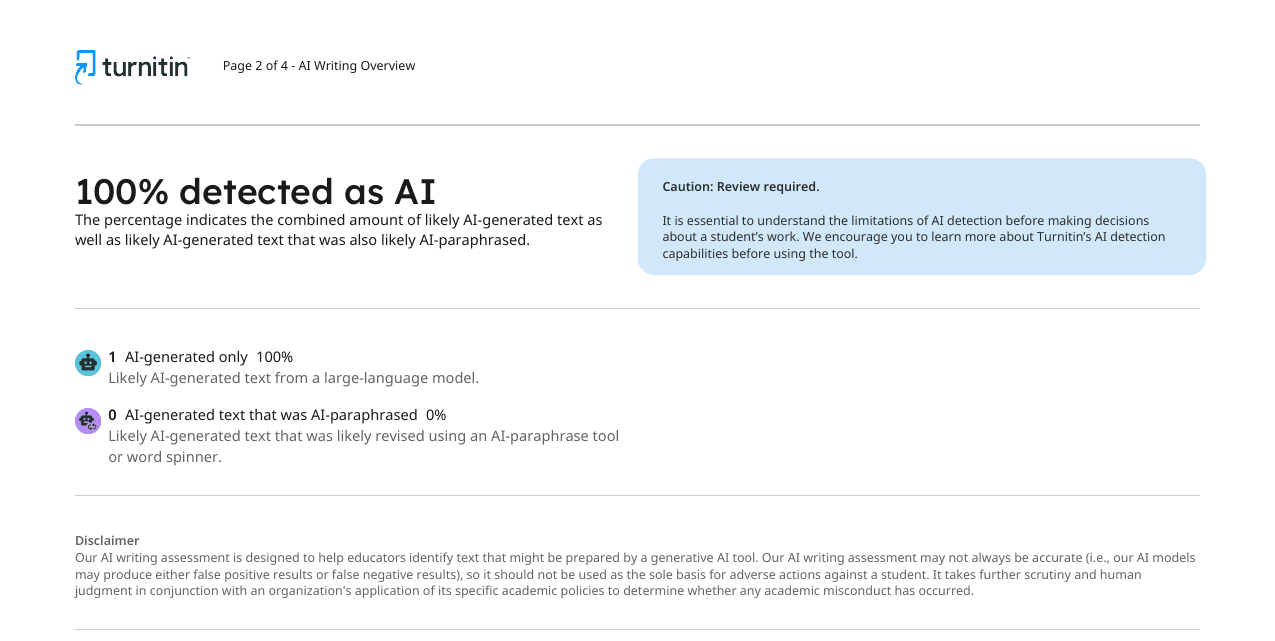
According to Turnitin’s own August 2024 white paper, the system runs on two proprietary, transformer-based models, AIW (AI writing detection) and AIR (AI rewriting detection), on this timeline:
- AIW-1 (April 2023). The first AI writing model. It had processed more than 250 million paper submissions by mid-2024.
- AIW-2 (December 2023). Replaced AIW-1, with better detection of AI text that’s been run through paraphrasing tools.
- AIR-1 (July 2024). Added a separate model to spot AI paraphrasing and “text spinner” output. Its results were shown as their own purple category until August 2026, when Turnitin merged them into the single AI-generated score. Turnitin only runs this paraphraser and bypasser check on English submissions — its Spanish and Japanese detectors do not include it.
Which AI models can Turnitin detect?
Turnitin’s detector isn’t tuned to one chatbot. Its models are trained on a broad mix of AI-generated and authentic academic writing spanning roughly two decades, so they look for the statistical fingerprint of large-language-model writing in general, the kind behind ChatGPT, Gemini, Claude and similar tools.
AIW-2 specifically improved at catching AI text that’s been pushed through paraphrasers (“text spinners”), and AIR-1 adds a dedicated check for AI-paraphrased sentences — since August 2026 those land inside the single AI-generated score rather than a separate purple category. There’s an honest caveat here. Text that’s been heavily rewritten by hand, or any passage under a few hundred words, is harder for any detector to call confidently, Turnitin’s included. For a model- and tool-by-tool breakdown, see whether Turnitin can detect ChatGPT, QuillBot and paraphrasers.
If you are looking for a tool-specific answer, the same principle applies: Turnitin can flag ChatGPT-style writing, AI-paraphrased text from tools like QuillBot, and heavy AI rewrites from writing assistants like Grammarly. It evaluates the final prose, not the brand name of the tool you used.
How Turnitin’s AI detector actually works
The white paper lays out the mechanics. Turnitin slides a “segment window” of about five to ten sentences across your document, one sentence at a time. Each window gets a score from 0 to 1 for how strongly it reads as AI-generated.
Those window scores are averaged into a per-sentence score and compared against a threshold. A document is only labeled AI-generated when more than 20% of its sentences cross that threshold. That 20% cutoff isn’t arbitrary: Turnitin found that below it, false positives climb, so the threshold is tuned to keep the document-level false-positive rate under 1%.
There’s also a length floor. The detector needs at least 300 words of actual prose (not lists, tables, or code) to run at all. Shorter submissions don’t give the model enough signal.
How accurate is Turnitin’s AI detector?
Turnitin’s headline claim is a 98% confidence rate with a false-positive rate under 1%. There’s a catch, though. That under-1% figure only applies to documents where at least 20% of the text is flagged, not to every paper.
Independent testing tells a more complicated story. A widely cited discussion of false positives, plus outside research on non-native English and neurodivergent writers, has found real-world false-positive rates can run higher, and Turnitin itself warns that scores are less reliable for short texts. So treat the number as a strong signal, not proof.
What your Turnitin AI score actually means
Since mid-2024, Turnitin no longer shows a number or highlights below 20%. It displays only an asterisk (*%), because the 1–19% range is where false positives concentrate. Here’s how to read what you do see:
- *% (under 20%): too unreliable to score; shown as an asterisk with no highlights.
- 20% and up: a real percentage appears. Low-to-moderate scores are usually a prompt to look closer, not an accusation.
- High (roughly 60–80%+): more likely to trigger a conversation or a formal review, but it’s still an indicator, and the burden of context is on the reader.
For the full breakdown of what each band means and how professors interpret it, see what happens when Turnitin flags your paper as AI.
Turnitin’s detector vs other AI detectors
The big difference isn’t just accuracy. It’s who controls the tool and who gets to run it:
| AI detector | Built by | Students can run it? | Notes |
|---|---|---|---|
| Turnitin (AIW + AIR) | Turnitin (in-house) | No, instructor-facing only | Built for academic work; flags AI writing and AI paraphrasing |
| GPTZero | Independent company | Yes, free and paid | Popular general-purpose AI detector |
| Originality.ai | Independent company | Yes, paid | Aimed at web publishers and SEO content |
| Copyleaks | Independent company | Yes, paid | AI detection + plagiarism for business and education |
Because Turnitin’s model is its own, a score from GPTZero or any free tool won’t match Turnitin’s. The only way to know your Turnitin number is to see a Turnitin report. For the direct comparison, read Turnitin vs GPTZero; for the broader tool search, see AI checkers like Turnitin.
Can you even see your Turnitin AI score before you submit?
Most students hit the same catch. Turnitin’s AI indicator is built for instructors. It appears in the Similarity Report your professor opens, not in your submission view. Most students never see their own AI score until it’s too late to do anything about it.
There are two ways to preview it before you hand work in:
- The real Turnitin report. Run your paper through the actual Turnitin to get the same AIW/AIR AI-writing report (and the similarity report) your instructor sees, processed privately and never added to any database.
Writing a college application essay rather than coursework? Do colleges use AI detectors for application essays covers what admissions offices actually do with them.
Frequently asked questions
What AI detector does Turnitin use?
Turnitin uses its own proprietary, in-house AI writing detection system, not a third-party tool. It runs on two transformer-based models: AIW (AI writing detection) and AIR (AI rewriting detection, which flags AI-paraphrased text). Both are built right into Turnitin Feedback Studio and the Similarity Report.
What does Turnitin use to detect AI?
Turnitin uses proprietary transformer-based models trained for academic writing. The AIW model scores likely AI-generated text, while the AIR model focuses on AI-rewritten or AI-paraphrased text.
Does Turnitin use GPTZero, Copyleaks, or Originality.ai?
No. Those are separate, independent AI detectors. Turnitin builds and trains its own models in-house, so a score from GPTZero or any other tool won’t match what Turnitin reports for the same document.
Which AI models can Turnitin detect?
Turnitin’s detector is trained to recognize text from large language models in general, the kind that power tools like ChatGPT, rather than one specific brand. Its December 2023 model (AIW-2) also catches AI text that’s been run through paraphrasers or “text spinners,” and the AIR-1 model adds a dedicated check for AI-paraphrased sentences — since August 2026 those results are folded into a single AI-generated score rather than shown separately. Text rewritten heavily by hand is harder for any detector to catch.
Is a 20% Turnitin AI score bad?
20% is the threshold where Turnitin starts showing an actual number. Below 20%, it displays only an asterisk (*%) because low scores have a higher chance of being false positives. A 20% score is on the low end, usually a reason to look closer rather than proof of misconduct.
Is a 40% Turnitin AI score bad?
A 40% AI score means Turnitin estimates roughly that share of the document matches AI-writing patterns, which many instructors treat as worth a conversation. It’s still an indicator, not a verdict. False positives happen, especially for formal or non-native writing, so context and your draft history matter.
Does Turnitin detect AI below 20%?
Its model still scores every qualifying document, but Turnitin deliberately doesn’t surface a percentage or highlights below 20%. Instead it shows an asterisk (*%), because scores in the 1–19% range are the least reliable and most prone to false positives.
How accurate is Turnitin’s AI detector?
Turnitin reports a 98% confidence rate and a document-level false-positive rate below 1%, but that figure only applies to documents where at least 20% of the text is flagged. Independent testing has found higher false-positive rates in some conditions, and Turnitin itself warns that scores are less reliable for shorter texts and for non-native English writers. Treat the score as a strong signal, not proof.
Can students see or use Turnitin’s AI detector themselves?
Usually no. Turnitin’s AI writing indicator is shown to instructors inside the Similarity Report, and most students never see their own AI score before submitting. To preview it, you have to run your paper through a service that returns the Turnitin report directly.
Can Turnitin detect ChatGPT, Gemini, or Claude?
Turnitin’s model is designed to generalize across large language models rather than detect one brand, so output from ChatGPT, Gemini, Claude and similar tools can all be flagged. Detection is hardest when AI text has been substantially edited or paraphrased by hand.
Can Turnitin detect AI text that was paraphrased with QuillBot?
Yes. Turnitin’s AIR-1 model, launched in July 2024, looks for the statistical signature of AI paraphrasing and “text spinner” tools. Since August 2026 those sentences are no longer broken out in a separate purple category — they are counted inside the single AI-generated score. Note that Turnitin only runs this paraphraser check on English submissions; its Spanish and Japanese detectors do not include it.
See the AI report your instructor sees
Turnitin’s AI detector is instructor-facing, but you can preview your own result first. Run your paper through the real Turnitin for the official AI-writing and similarity report, deleted within 24 hours and never added to a repository.
Run a real Turnitin checkNot affiliated with, endorsed by, or sponsored by Turnitin, LLC. “Turnitin” is a trademark of Turnitin, LLC, used here descriptively.