How Turnitin catches copied text
Turnitin fingerprints your document and compares it against its index: public web pages (including archived versions), subscription journals and books, and the repository of previously submitted student papers. Overlapping passages come back highlighted with their sources in the Similarity Report. That is the core mechanism — if you want the full tour, read how Turnitin works.
Two properties of this design matter for the copy-paste question. First, it is content-based: Turnitin never needs to know how the words got into your file. Second, it is source-based: the match appears whether you copied from the original site or from someone who copied it first. Deleting your browser history changes nothing.
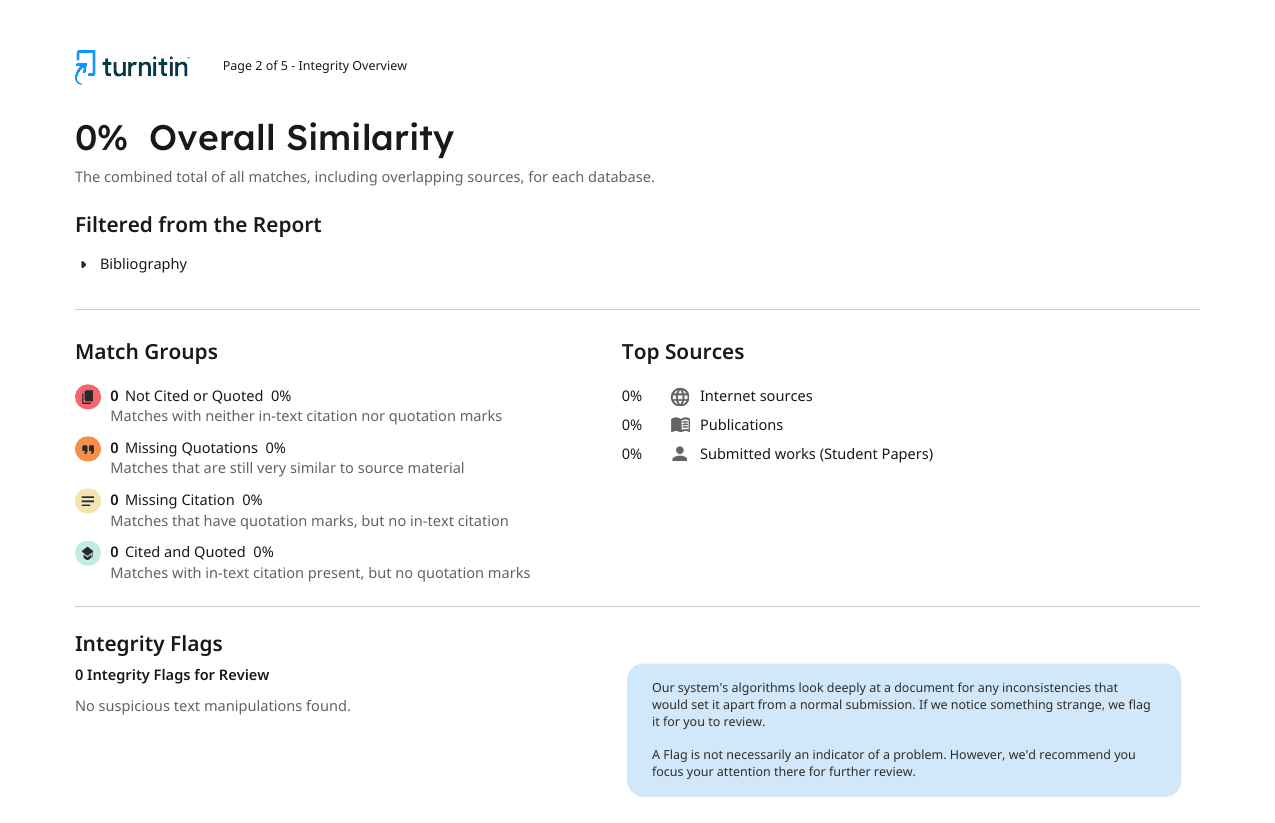
Copy and paste from a PDF
A surprisingly common hope is that PDFs are somehow outside the index — the text came from a "file," not a website. In practice the opposite is true. Academic PDFs are exactly what Turnitin’s content partnerships index most heavily: journal articles, textbooks, conference papers, theses. Text copied out of a PDF is plain text once it lands in your document, and its source is very likely in the comparison database already.
The same goes for copying from lecture slides, course readers, or a past student’s essay — that last one lands in the student paper repository the moment it is submitted to a standard assignment, and stays there.
What about images, screenshots, and flattened PDFs?
Because the similarity check reads extractable text, some students try to outrun it with formatting: paste the essay as a screenshot, flatten the PDF so nothing is selectable, or hide characters in images. Turnitin’s own file requirements close most of that door: PDF image files, forms, and files without highlightable text are not accepted for similarity checking, and submissions need a minimum amount of real text to process at all.
We see the same thing operationally: image-only uploads fail pre-flight checks before a report can even run, because there is no prose to analyze. And even when a file slips through somewhere, the mismatch is glaring to a human — an "essay" the instructor cannot select text in is itself evidence that something was hidden. The trick does not beat the detector; it replaces a similarity problem with a misconduct problem.
Does rewording the copied text help?
Swapping synonyms while keeping the sentence skeleton is close paraphrasing, and Turnitin can still match it. Running the copied passage through an AI rewriter is worse: the similarity side may drop, but the AI-paraphrase side of the report is built to flag exactly that. And pasting AI-generated text instead of copied text just moves the problem to the AI-writing score — see can Turnitin detect ChatGPT.
The honest route is also the low-scoring one: quote what you take verbatim, cite it, and paraphrase from understanding rather than from the sentence in front of you. What each percentage band means is covered in the similarity score guide.
How to check what your paper matches
If parts of your draft leaned on sources and you are not sure how much overlap is left, do not guess. Run a pre-submission check through the real Turnitin: you get the same highlighted Similarity Report your instructor would see, plus the AI-writing score, while there is still time to quote, cite, and rewrite properly.
Frequently asked questions
Can Turnitin detect copy and paste?
Yes. Turnitin does not need to see the act of pasting; it compares your final text against web pages, journals, and student papers. If the words match a source, they match, whether they were typed or pasted.
Can Turnitin detect copy and paste from a PDF?
Yes. Text copied out of a PDF is just text, and the PDF itself is often already in Turnitin’s database — journal articles, books, and lecture materials are heavily indexed. Where the text came from does not change whether it matches.
Can Turnitin read text inside images or screenshots?
The similarity check reads extractable text, not pixels. But submitting text as images fails for other reasons: Turnitin rejects files without highlightable text, word minimums are not met, and the formatting mismatch is obvious to an instructor.
Can Turnitin detect copying from another student’s paper?
Yes, if that paper is in the student paper repository — and standard assignments add submissions to it. Copying from a past student’s essay is one of the most reliably caught forms of overlap.
Does changing a few words stop Turnitin from detecting it?
Usually not. Swapping synonyms while keeping sentence structure is close paraphrasing; Turnitin can still match the pattern, and AI-assisted rewording can additionally trigger the AI-paraphrase side of the report.
Can Turnitin tell if I pasted from ChatGPT?
Pasted AI text usually has no source to match, so it shows up on the AI-writing side instead of the similarity side. A paper can score 0% similarity and still be flagged as AI-generated.