What does your Turnitin AI score mean?
Short answer: there’s no official “safe” or “good” Turnitin AI score. The percentage estimates how much of your text reads as AI-written. It is not a ruling that you cheated. Turnitin hides any score under 20% behind an asterisk (*%) because low scores aren’t reliable. At 20% and up you get a real number, and a higher one means more scrutiny. Either way, it’s an indicator, not proof.
What the Turnitin AI score actually measures
The AI writing score is Turnitin’s estimate of the percentage of your document that reads as AI-generated. It works sentence by sentence: per Turnitin’s AI writing detection model documentation, its model scores how strongly each passage matches the statistical patterns of AI writing, then reports the share of your text that crosses its threshold.
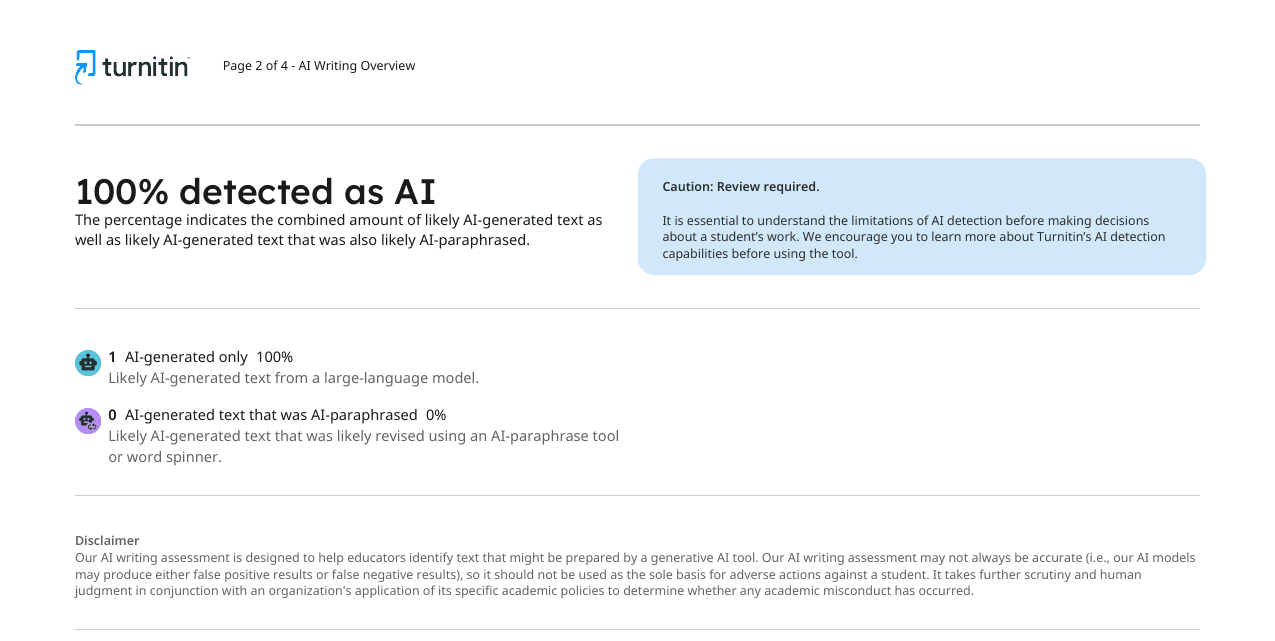
It is separate from the similarity (plagiarism) score. Similarity measures how much of your text matches existing sources; the AI score measures how much reads as machine-written. You can score 0% similarity and still get a high AI score. (For how the detector itself works and which models it catches, see what AI detector Turnitin uses.) If your course drafts inside Turnitin, a third signal exists alongside these two — see Turnitin Clarity.
Turnitin AI score breakdown: 0% to 100%
What each range tends to mean, and what it usually means for you as a student:
| AI score | What it likely means | What it means for you |
|---|---|---|
| 0% | No passages read as AI-written. | Nothing got flagged. Keep your drafts and version history anyway. |
| *% (1–19%) | Turnitin hides the exact number behind an asterisk. Low confidence, higher false-positive risk. | Usually treated as effectively clear; no sentences get highlighted in the report. |
| 20–49% | A minority-to-moderate share of your text reads as AI-written. | Expect a closer look. Be ready to show your process and drafts. |
| 50–79% | A majority of the text reads as AI-written. | Likely a conversation or review. Bring your version history and notes. |
| 80–100% | Almost all of the text reads as AI-written. | High scrutiny. You’ll need solid evidence that you wrote it. |
Turnitin only officially defines the under-20% asterisk. The ranges above 20% are general interpretation, not official cutoffs. Turnitin gives you a number, not a label, and the number is an indicator, never automatic proof of misconduct.
What does the asterisk (*%) mean?
If your report shows *% instead of a number, your AI score landed in the 1–19% range. Since July 2024, Turnitin deliberately stops showing a percentage or highlighting any sentences below 20%, because — as its false-positive research explains — scores in that range have a much higher chance of being false positives.
So a *% is the least reliable result, and most instructors treat it as effectively clear. It doesn’t mean “1–19% of your paper is AI” with any confidence. It means Turnitin saw a faint signal it won’t stand behind. When a real number does show up (20%+), the AI-flagged sentences are highlighted in blue. Since August 2026 that is one single category: likely AI-generated text, including passages later rewritten with an AI paraphraser or bypasser. The separate purple highlight Turnitin used to show for AI-paraphrased text has been retired.
If you are holding a report generated before that update, it still shows the old two-colour split, and it stays that way — Turnitin does not retroactively redraw old reports. The paper has to be submitted again to get one in the new single-category format.
Is 20% bad? Is 40% bad? What’s a “good” score?
There’s no universal pass mark, and anyone who hands you one exact number is guessing. Roughly, though:
- Under 20% (*%): usually fine. Often a false-positive-prone signal Turnitin won’t even quantify.
- Around 20–40%: a “look closer” zone. Many instructors will want to understand it, especially if your course expects little or no AI use. Not an automatic problem.
- Above 40–50%: more likely to trigger a conversation or review. Still rebuttable with drafts and version history, but you’ll want that evidence ready.
What matters most isn’t the number. It’s your course policy. Some classes expect 0% and ban AI outright. Others allow disclosed AI help. Check your syllabus before you panic over a percentage.
Real examples: what different scores can mean
A 12% (shown as *%) on a lab report
Technical, templated writing (methods, results, standardized phrasing) often trips low signals. Shown as *%, it’s almost always treated as clear. Nothing to do here but keep your notes.
A 28% on a policy essay
A real number, so some passages read as AI. If you wrote it yourself, this is the classic “formal, structured prose looks AI-like” case. Be ready to walk through your drafts; don’t assume you’re in trouble.
A 63% on a personal reflection
A majority flagged on a piece that’s supposed to be in your own voice is worth taking seriously. Either it leaned on AI, or it’s a real false positive. Your version history is your best friend here.
A 92% on a research paper
Almost everything reads as AI. Expect real scrutiny. If you wrote it, you’ll need strong, specific evidence of your process; if you used AI, your course policy determines what happens next.
Why your score might be high even if you didn’t use AI
False positives are real, and they cluster in predictable places. Detectors look for smooth, even, predictable prose, which is exactly what careful academic writing produces. Scores can run high for:
- Non-native English writers, whose phrasing can overlap with AI patterns
- Formal or formulaic writing like lab reports, legal briefs, and methods sections
- Text heavily edited with grammar tools, which makes it more uniform
That’s why a number is never proof on its own. If your own work comes back high, read what to do when Turnitin flags your paper as AI.
Frequently asked questions
What is a good Turnitin AI score?
There is no official “good” or “safe” number. Turnitin treats the score as an estimate, not a pass/fail line. In practice, anything Turnitin hides behind an asterisk (under 20%) is usually treated as effectively clear, and a real percentage only shows up at 20% and above. What counts as acceptable comes down to your course or institution’s policy.
Is a 20% AI score bad?
20% is just the point where Turnitin starts showing a real number instead of an asterisk. It’s on the low end, usually a reason to look closer rather than proof of misconduct. Formal, technical, or non-native writing can land here with no AI use at all, so keep your drafts in case someone asks.
Is a 40% Turnitin AI score bad?
A 40% score means Turnitin thinks roughly that share of your text reads as AI-written, which many instructors treat as worth a conversation. It’s still an indicator, not a verdict. False positives happen, so context and proof of your writing process matter more than the number by itself.
What does *% mean on Turnitin?
An asterisk (*%) means your AI score landed in the 1–19% range. Since July 2024, Turnitin stopped showing a number or any highlights below 20%, because low scores are more likely to be false positives. A *% is the least reliable result, and most instructors treat it as effectively clear.
What is an acceptable AI score on Turnitin?
There is no universal cutoff. A lot of instructors treat an asterisk or a low score as fine, get curious in the 20–40% range, and get concerned above that. But policies vary a lot. Some courses expect 0%, others allow disclosed AI use. Check your syllabus instead of chasing a magic number.
Does a 0% AI score mean no AI was used?
Not necessarily. A 0% means Turnitin didn’t find AI-like patterns, but detectors miss text that’s been heavily edited by hand or run through a paraphraser. It’s reassuring, but it isn’t proof either way.
Is the AI score the same as the similarity (plagiarism) score?
No, they’re two separate numbers. The AI score estimates how much of your writing reads as AI-generated. The similarity score measures how much of your text matches existing sources. You can have 0% similarity and still get a high AI score, or the other way around.
Can a high Turnitin AI score be a false positive?
Yes. Turnitin claims a document-level false-positive rate under 1% (for documents where at least 20% gets flagged), but independent testing has found higher rates in some conditions, and formal, non-native, or neurodivergent writing is more likely to be misread. Treat a high score as a reason to investigate, not as proof.
How can I see my Turnitin AI score before I submit?
You normally can’t. Turnitin’s AI indicator is shown to instructors, not students. To preview it, run your paper through a free AI-writing estimate for a quick gut-check, or run the real Turnitin check to see the actual report your instructor sees before you hand it in.
Check your AI score before your professor does
You normally can’t see your own Turnitin AI score. Run the real Turnitin check for the official AI-writing and similarity report. It’s deleted within 24 hours and never added to a repository.
Not affiliated with, endorsed by, or sponsored by Turnitin, LLC. “Turnitin” is a trademark of Turnitin, LLC, used here descriptively.