What Turnitin officially claims
Turnitin’s AI writing detection model documentation describes a detector trained to keep the document-level false positive rate under 1%. Read the fine print, though, and the claim is narrower than the headline: it applies to long-form prose of roughly 300 words or more, and only to documents where more than 20% of the qualifying sentences look AI-generated. Anything scoring 1-19% is hidden behind an asterisk (*%) precisely because Turnitin’s own false positive analysis found that low range less reliable.
In other words: the "under 1%" figure is real, but it is achieved partly by refusing to report the scores the model is least sure about. That is a reasonable engineering trade-off — and a very different thing from "99% accurate on everything."
What the pushback says
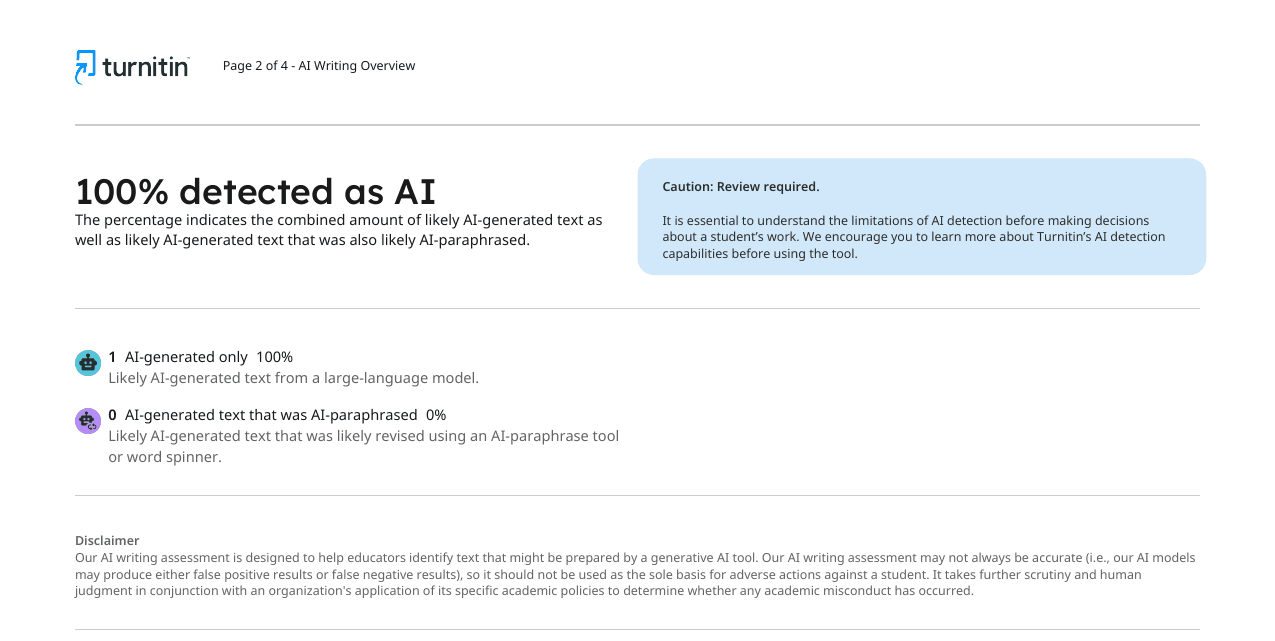
The counter-evidence is not internet folklore. Vanderbilt University disabled Turnitin’s AI detector citing false positive concerns. A widely cited newspaper test on a small mixed sample caught only about half of the AI-assisted essays. And peer-reviewed research on AI detectors has repeatedly found they flag writing by non-native English speakers at higher rates — formal, careful, standardized prose reads as "machine-like" to a pattern detector.
None of these tests is large enough to replace Turnitin’s own numbers. But they are consistent about the failure modes: short texts, heavily edited texts, formulaic academic writing, and ESL writing are where the detector is weakest in both directions.
How both can be true at once
The official stats and the Reddit horror stories describe the same system from different ends. The detector processes millions of papers; even a false positive rate genuinely under 1% means a steady stream of wrongly flagged students — and those students post about it, while the silent majority never mentions Turnitin at all. Averages and edge cases are both real.
That is also why Turnitin frames the score as an indicator for an instructor to review, not an accusation. The number starts a conversation; it should not end one. For what the percentage itself means band by band, read the Turnitin AI score explained, and for the model behind it, what AI detector Turnitin uses.
Accuracy compared with other detectors
Students often cross-check with GPTZero, Grammarly, or free online "Turnitin detectors." Useful as an early warning — but different models score differently, and no third-party tool runs Turnitin’s actual detector. A clean Grammarly or GPTZero result cannot clear you for Turnitin, and a scary one does not condemn you. We compared the two ecosystems in Turnitin vs GPTZero; the short version is that only the report your school runs decides anything. And if your course drafts inside Turnitin, accuracy is not the only signal in play — see Turnitin Clarity.
What this means for your paper
If you wrote honestly and worry about a false flag, the practical moves are boring but effective: keep drafts and version history, write with your sources open and cited, and avoid running your prose through smoothing tools that erase your personal rhythm. If a flag does land, work through the Turnitin false positive guide — it covers evidence, the meeting, and the appeal.
And if you want certainty instead of probability debates, check your score before submitting. Whatever the detector’s average accuracy is, the only number that matters for you is the one on your report.
Frequently asked questions
Is Turnitin AI detector accurate?
It is accurate enough that schools rely on it, and imperfect enough that Turnitin itself calls the score an indicator, not proof. Officially it claims a document-level false positive rate under 1%, but that figure comes with conditions: long-form prose, 300+ words, and a 20% reporting threshold.
How accurate is Turnitin AI detection really?
There is no single number. Turnitin reports high accuracy under its own test conditions, while independent spot checks have caught it missing AI text and flagging human text, especially on short, heavily edited, or non-native English writing.
Why does Turnitin hide scores under 20%?
Turnitin found the 1-19% range had a higher rate of false positives, so since 2024 it shows an asterisk (*%) instead of a number there. That design choice trades away sensitivity in the low range to keep the headline false positive rate under 1%.
Is Grammarly’s AI detector as accurate as Turnitin?
They are different models with different thresholds, so their scores do not predict each other. Grammarly can be a useful early warning, but only the Turnitin report shows what your instructor actually sees.
Why do people on Reddit say Turnitin is wrong?
Both things are real: most papers score without incident, and a visible minority get false positives — those students are the ones who post. Anecdotes measure the painful edge cases; official stats measure the average. Neither cancels the other out.
Are free "Turnitin AI detectors" online accurate?
Free tools with Turnitin in the name are not running Turnitin’s model — the real detector is only available inside Turnitin’s products. Free checkers can give a rough estimate, but the number your school sees can differ a lot.